
Gujarat is one of India’s most fascinating travel destinations, offering a remarkable combination of historical landmarks, religious sites, natural attractions, traditional arts, and delicious regional cuisine. Located in the western part of India, the state is known for its diverse landscapes, ranging from the white salt desert of Kutch to the forests of Gir and the coastline along the Arabian Sea.
Gujarat tourism attracts visitors interested in history, spirituality, wildlife, architecture, and cultural experiences. The state is home to several internationally recognised heritage attractions, including Rani-ki-Vav, Dholavira, and the historic city of Ahmedabad.
Beyond its famous monuments, Gujarat has a vibrant cultural identity. Traditional Garba performances, colourful festivals, handmade textiles, local handicrafts, and distinctive Gujarati food make travelling through the state an interesting experience.
Famous Tourist Destinations in Gujarat
Gujarat has numerous tourist destinations that attract visitors throughout the year. Some places are famous for their historical importance, while others are recognised for their natural beauty, religious significance, and unique experiences.
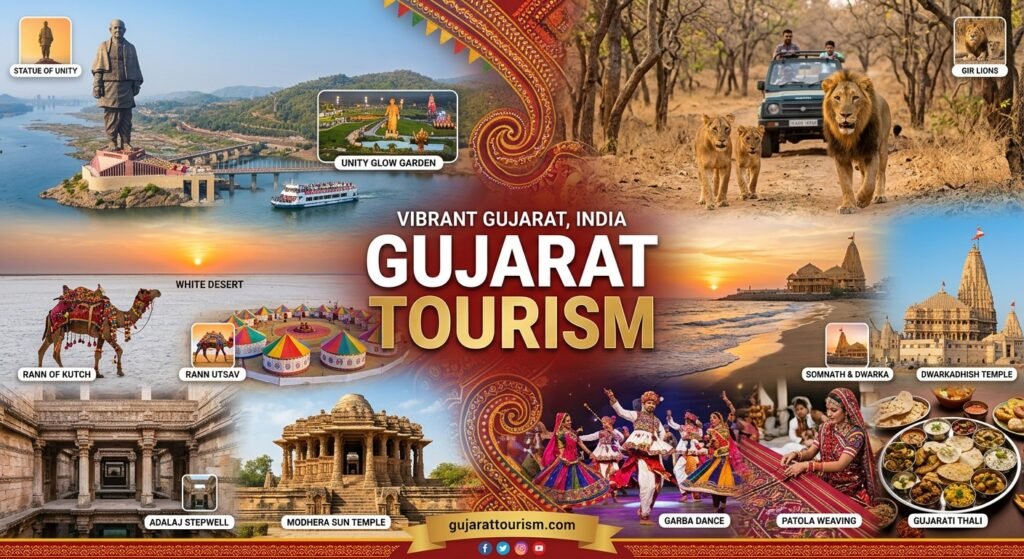
Statue of Unity – A World-Famous Landmark
The Statue of Unity is one of Gujarat’s most recognisable attractions. Located near Kevadia in the Narmada district, this enormous monument was built in honour of Sardar Vallabhbhai Patel, India’s first Deputy Prime Minister and Home Minister.
Standing approximately 182 metres tall, the Statue of Unity was inaugurated on 31 October 2018. It represents Patel’s contribution to India’s independence and the integration of hundreds of princely states after independence.
Visitors can explore the monument, enjoy views of the surrounding landscape, and discover attractions in the wider Statue of Unity area. Some popular experiences include the Valley of Flowers, Cactus Garden, Butterfly Garden, and Ekta Mall.
Rann of Kutch – Exploring the White Desert
The Rann of Kutch is one of the most distinctive natural attractions in Gujarat. This enormous salt marsh becomes especially attractive when its white surface creates a striking landscape under the open sky.
Located in the Kutch region, the White Rann is particularly popular during the cooler months. Sunrise, sunset, and moonlit evenings offer different views of the salt-covered landscape.
One of the major attractions is Rann Utsav, a cultural festival that introduces visitors to the traditions and artistic heritage of Kutch. The celebration features folk music, traditional dances, handicraft exhibitions, regional food, and cultural performances.
Somnath Temple – A Historic Spiritual Destination
Somnath Temple is among the most important religious destinations in Gujarat. Located at Prabhas Patan near Veraval, the temple stands beside the Arabian Sea and is widely associated with Lord Shiva.
Somnath is traditionally revered as the first of the twelve Jyotirlingas. Its religious importance attracts pilgrims from different parts of India throughout the year.
The present temple structure was reconstructed in 1951. Its traditional architectural design, detailed carvings, and coastal surroundings make it an important destination for both religious visitors and people interested in Indian heritage.
Visitors can explore the temple complex, participate in religious activities, and enjoy the surrounding coastal scenery.
Dwarka – The Sacred City of Gujarat
Dwarka is a famous pilgrimage destination associated with Lord Krishna. Located along Gujarat’s western coastline, the city is an important centre of Hindu religious tradition.
The Dwarkadhish Temple is the principal attraction. Also known as Jagat Mandir, it is dedicated to Lord Krishna and attracts pilgrims throughout the year.
Visitors can admire the temple’s traditional architecture, observe religious ceremonies, and experience the spiritual atmosphere of the surrounding streets. Other notable places include Rukmini Devi Temple, Nageshwar Jyotirlinga, and Gomti Ghat.
Gir National Park – Home of the Asiatic Lions
Gir National Park and Wildlife Sanctuary is one of Gujarat’s most important wildlife destinations. It is internationally recognised as the natural habitat of the Asiatic lion.
Located in the Saurashtra region, Gir contains forests, grasslands, hills, and water sources that support different wildlife species.
Visitors can experience organised jungle safaris and explore the natural environment while learning about wildlife conservation. Besides Asiatic lions, the region supports animals such as leopards, deer, nilgai, and several bird species.
Historical Places and Heritage Sites in Gujarat
Gujarat has a long and fascinating history reflected in its archaeological remains, historic cities, temples, and traditional buildings. Its heritage destinations provide opportunities to understand ancient settlements, architectural development, and different cultural influences.
Rani Ki Vav – A UNESCO World Heritage Site
Rani-ki-Vav is a remarkable historic stepwell located in Patan, Gujarat. It was constructed during the 11th century and is recognised for its elaborate underground architecture and detailed sculptures.
The structure was originally built as a memorial and combines practical water-management functions with religious and artistic elements.
Rani-ki-Vav features seven levels of stairs and numerous sculptural decorations depicting religious figures, mythological stories, and other subjects. Its design resembles an inverted temple, reflecting the cultural importance of water in traditional Indian architecture.
Champaner-Pavagadh Archaeological Park
Champaner-Pavagadh Archaeological Park is another important UNESCO World Heritage Site in Gujarat. Located in the Panchmahal district, the site contains archaeological remains, historic buildings, temples, fortifications, and water-management structures. The archaeological landscape reflects different historical periods, including prehistoric settlements and the remains of Gujarat’s 16th-century capital.
One of its notable attractions is the Jama Masjid, which demonstrates an interesting combination of Hindu and Islamic architectural influences. Pavagadh Hill is also home to the Kalika Mata Temple, an important religious destination that attracts pilgrims.
Dholavira – Exploring Ancient Indus Valley History
Dholavira is one of the most significant archaeological destinations in Gujarat. Located on Khadir Island in the Kutch region, it was an important urban settlement of the ancient Harappan Civilization.
The settlement was occupied approximately between 3000 BCE and 1500 BCE. Archaeological discoveries have revealed a carefully planned city with fortified sections, residential areas, gateways, reservoirs, and drainage systems.
One of Dholavira’s most remarkable features is its sophisticated water-management system. The ancient inhabitants developed methods of collecting and storing water to survive in a region where water resources were limited.
Ahmedabad – A City of Historic Architecture
Ahmedabad is one of Gujarat’s most historically important cities. Founded by Sultan Ahmad Shah I in 1411, it developed into an important centre of trade, architecture, and cultural activity.
The Historic City of Ahmedabad was recognised as India’s first UNESCO World Heritage City in 2017.
The old city is known for its traditional neighbourhoods, locally called pols, historic mosques, temples, wooden houses, and distinctive architectural features. Important attractions include Jama Masjid, Sidi Saiyyed Mosque, Bhadra Fort, and the historic residential areas.
Gujarat’s Rich Culture and Traditions
Gujarat’s cultural identity is shaped by its festivals, traditional clothing, music, dance, regional languages, and handicrafts. The state has different cultural communities, each contributing to its artistic and social traditions. Visitors can experience this diversity through village visits, local markets, religious celebrations, and cultural events.
Traditional Festivals and Celebrations
Festivals are an important part of Gujarat’s cultural life. They bring communities together through music, dance, religious activities, traditional food, and colourful celebrations.
Navratri is one of the most famous festivals in Gujarat. It is celebrated over nine nights and is closely associated with the worship of the goddess Shakti.
Uttarayan, also known as the International Kite Festival in Ahmedabad, is another popular celebration. During this festival, colourful kites fill the skies, and people gather on rooftops to enjoy the festivities.
Garba and Dandiya Raas Dance
Garba and Dandiya Raas are two well-known traditional dance forms associated with Gujarat.
Garba is traditionally performed during Navratri. Participants dance in circular formations, often around a decorated central arrangement associated with the goddess Amba. Singing, clapping, and rhythmic movements are important elements of the performance.
Dandiya Raas involves dancing with decorated wooden sticks. Participants move in coordinated patterns while striking their sticks to the rhythm of traditional and contemporary music.
Traditional Clothing, Art, and Handicrafts
Gujarat is widely recognised for its colourful textiles and traditional handicrafts. Bandhani is a traditional tie-dye textile technique that creates patterns through carefully tied sections of fabric. Patola textiles from Patan are particularly famous for their intricate double-ikat weaving.
Kutch is another important centre of traditional craftsmanship. Its artisans are known for embroidery, Ajrakh block printing, Rogan painting, leatherwork, metalwork, and decorative handicrafts.
Traditional clothing often includes colourful embroidered garments, chaniya cholis, kediyu outfits, turbans, and regionally distinctive accessories.
Gujarati Customs and Local Lifestyle
Gujarati lifestyle reflects a combination of family traditions, regional customs, religious practices, business activities, and community celebrations. Gujarati is the principal language of the state, although Hindi and English are also used in many urban and tourist areas.
Hospitality is an important part of local social life. Traditional meals, family gatherings, religious celebrations, and community events often provide opportunities for people to spend time together.
Famous Gujarati Food and Traditional Cuisine
Food is an important part of Gujarat’s cultural identity. Gujarati cuisine is known for its variety of flavours, traditional cooking techniques, snacks, vegetarian dishes, and regional specialities.
Although many traditional dishes are vegetarian, visitors can discover considerable variety in ingredients, textures, and preparation methods.
Popular Gujarati Dishes to Try
Gujarati cuisine includes several delicious dishes that visitors should consider trying. Dhokla is a popular steamed savoury snack made primarily from fermented gram flour or other suitable flour mixtures. It is generally served with chutney and seasoning.
Khaman is another well-known gram-flour-based snack, commonly served with green chillies and garnishes.
Khandvi consists of thin, soft gram-flour rolls seasoned with mustard seeds, coconut, and curry leaves. Thepla is a traditional flatbread that is often prepared with wheat flour, spices, and fenugreek leaves.
Traditional Gujarati Thali
A Gujarati thali is a traditional meal served with several different dishes arranged together on one platter. A typical thali may include dal, vegetable preparations, pulses, rice, roti, farsan, chutneys, pickles, and sweets.
Some meals also include kadhi, khichdi, yoghurt-based dishes, and buttermilk. One interesting feature of a traditional Gujarati thali is the balance of different tastes and textures. Sweet, sour, salty, and spicy flavours may appear together in the same meal.
Famous Street Foods and Local Snacks
Gujarat has a lively street-food culture, especially in cities such as Ahmedabad, Surat, and Vadodara. Fafda and jalebi are a popular combination, particularly during festive occasions. Fafda is a crispy gram-flour snack, while jalebi is a sweet preparation made from batter and syrup.
Popular Gujarati Sweets and Desserts
Gujarati desserts offer another interesting part of the state’s culinary heritage. Shrikhand is a popular yoghurt-based dessert known for its smooth texture and sweet flavour. It is often flavoured with cardamom or saffron.
Basundi is a milk-based dessert prepared by reducing milk and adding sugar and flavourings.
Best Time to Visit Gujarat
Choosing the right travel season can make a significant difference when planning a trip to Gujarat. The state experiences hot summers, a monsoon season, and comparatively cooler winters. The best time depends on the attractions visitors want to explore and the activities they plan to enjoy.
Exploring Gujarat During Winter
Winter, generally from November to February, is considered one of the most comfortable periods for exploring many parts of Gujarat. Temperatures are usually more suitable for sightseeing, outdoor activities, wildlife experiences, and visiting historical monuments.
This season is particularly attractive for visiting the Rann of Kutch, exploring Ahmedabad, discovering heritage sites, and travelling between different cities. It is also a popular period for cultural tourism because Rann Utsav takes place during the cooler months.
Monsoon Travel Experiences
The monsoon season generally extends from June to October, although rainfall conditions vary across the state. Rainfall can transform some landscapes, making selected natural destinations more attractive.
Travellers interested in greenery and quieter sightseeing may enjoy visiting certain regions during this period.
Summer Travel and Weather Conditions
Summer in Gujarat generally extends from March to May. During this period, temperatures can become very high, particularly in inland and desert regions.
Travellers planning summer visits should prepare for heat by carrying drinking water, wearing lightweight clothing, and avoiding prolonged outdoor activities during the hottest hours.
Indoor attractions, museums, shopping centres, and selected early-morning sightseeing activities may be more comfortable options. Although summer is not the most comfortable season for extensive sightseeing, it can still work for visitors with flexible travel plans.
Best Time to Experience Rann Utsav
Rann Utsav is generally organised during the cooler months, with the festival season usually extending from late autumn into winter.
The festival offers visitors opportunities to explore the White Rann, experience Kutchi folk music and dance, purchase handicrafts, and enjoy traditional food.
Full-moon nights are particularly popular because the white salt landscape creates a distinctive visual experience. The exact festival dates, accommodation availability, entry requirements, and activity schedules can change each year.
Best Things to Do in Gujarat
Gujarat offers many activities beyond visiting famous monuments. Travellers can explore wildlife areas, discover traditional markets, experience cultural performances, and learn about the state’s historical background.
Explore Wildlife and Natural Attractions
Wildlife exploration is one of the most interesting experiences in Gujarat. Gir National Park is the leading destination for people interested in seeing the Asiatic lion in its natural habitat.
Visitors can also explore the landscapes of the Rann of Kutch, enjoy the coastal environment, and discover wetlands and other natural areas. Birdwatching, nature photography, and organised wildlife experiences can make a trip more memorable.
Discover Historical Monuments and Temples
History and architecture enthusiasts can explore many important attractions throughout Gujarat. Rani-ki-Vav, Champaner-Pavagadh, Dholavira, and Ahmedabad’s historic city area are particularly valuable destinations for understanding the state’s heritage.
Religious attractions such as Somnath, Dwarka, Ambaji, and Palitana offer additional opportunities to explore traditional architecture and spiritual practices.
Experience Local Markets and Handicrafts
Exploring local markets is an enjoyable way to discover Gujarat’s traditional arts and crafts. Visitors can find Bandhani textiles, Patola fabrics, embroidered clothing, handmade jewellery, wooden products, and decorative items.
Kutch is particularly well known for its traditional embroidery and craft traditions. Ahmedabad and other major cities also offer shopping areas where visitors can discover regional products.
Enjoy Traditional Festivals and Cultural Events
Attending local festivals is one of the best ways to experience Gujarat’s cultural identity. Navratri offers opportunities to enjoy Garba and Dandiya Raas performances.
Rann Utsav introduces visitors to the music, food, crafts, and traditions of Kutch. Uttarayan provides another memorable cultural experience through kite-flying activities and community celebrations. Festival dates and programmes vary, so checking official announcements before travelling is important.
Popular Religious and Spiritual Destinations in Gujarat
Gujarat has a strong religious heritage, with numerous temples and pilgrimage destinations attracting visitors throughout the year. These destinations are important not only for religious reasons but also for their architecture, cultural traditions, and historical associations.
Somnath Temple
Somnath Temple is one of the most respected Shiva pilgrimage destinations in India. It is traditionally recognised as the first of the twelve Jyotirlingas. Its coastal location and architectural design make it an important attraction for pilgrims and general visitors.
The temple provides an opportunity to experience religious ceremonies and understand the continuing importance of Hindu pilgrimage traditions.
Dwarkadhish Temple
Dwarkadhish Temple is dedicated to Lord Krishna and is located in the sacred city of Dwarka. The temple is an important destination for Krishna devotees and forms part of the city’s wider pilgrimage landscape.
Its traditional architecture, religious ceremonies, and spiritual atmosphere attract visitors throughout the year.
Ambaji Temple
Ambaji Temple is a significant Shakti pilgrimage destination in Gujarat. Located in the Banaskantha district, the temple is associated with the worship of the goddess Amba.
The temple attracts large numbers of devotees, particularly during important religious festivals. Visitors interested in religious traditions and pilgrimage culture can include Ambaji in their Gujarat travel itinerary.
Palitana Jain Temples
Palitana, located in the Bhavnagar district, is famous for its extensive collection of Jain temples on Shatrunjaya Hill. The hill is an important pilgrimage destination for followers of Jainism.
The temple complex is recognised for its detailed stone architecture, religious significance, and remarkable setting.
Visitors should understand that the pilgrimage involves climbing many steps, so appropriate footwear, physical preparation, and awareness of local temple rules are important.
Read more: Great Learning for Beginners: A Guide to Starting Your Online Education
Travel Tips for Exploring Gujarat Tourism
Planning ahead can make a Gujarat trip more comfortable and enjoyable. Visitors should consider transportation, accommodation, local customs, weather, and safety before beginning their journey.
Transportation and Getting Around Gujarat
Gujarat has several transportation options for domestic and international visitors. Ahmedabad is an important entry point, with an international airport and major railway connections.
Other cities, including Vadodara, Surat, Rajkot, Bhuj, and Jamnagar, also have transportation facilities. For travel between cities, visitors can use trains, state-operated buses, private buses, taxis, and rental vehicles.
Accommodation and Budget Planning
Gujarat offers different accommodation options, including budget hotels, guesthouses, mid-range properties, and luxury hotels. Major cities generally provide more choices, while accommodation around popular pilgrimage sites and tourist destinations may have limited availability during festivals.
Visitors should consider transportation, food, accommodation, attraction tickets, and local travel when preparing their budgets.
Local Customs and Travel Etiquette
Respecting local customs is important when visiting Gujarat. At religious sites, visitors should follow the instructions of temple authorities, dress appropriately, and observe photography restrictions.
Some religious establishments have specific rules regarding footwear, food, or entry procedures. When visiting traditional villages or artisan communities, travellers should ask permission before photographing people or their private property.
Essential Travel Safety Tips
A little preparation can help make travelling through Gujarat safer and more comfortable. Visitors should keep identification documents secure, use reputable transportation providers, and choose accommodation with reliable facilities.
During summer, drinking sufficient safe water and protecting yourself from excessive heat are particularly important. For wildlife safaris, follow the instructions of authorised guides and maintain a safe distance from animals.
Final Thoughts
Gujarat is a fascinating destination that offers much more than conventional sightseeing. Its historical monuments, ancient archaeological sites, religious landmarks, natural landscapes, traditional handicrafts, and regional cuisine create a diverse travel experience.
From exploring the impressive Statue of Unity to experiencing the white landscape of the Rann of Kutch, visitors can discover many different aspects of the state. Historic destinations such as Rani-ki-Vav, Dholavira, and Ahmedabad provide valuable insights into India’s architectural and cultural development.
FAQs About Gujarat Tourism
1. What Is Gujarat Famous for in Tourism?
Gujarat is famous for its historical monuments, religious destinations, wildlife, traditional handicrafts, festivals, and regional cuisine. Major attractions include the Statue of Unity, Rann of Kutch, Somnath Temple, Dwarka, and Gir National Park.
2. Which Are the Best Tourist Destinations in Gujarat?
Some of the best tourist destinations in Gujarat include the Statue of Unity, Rann of Kutch, Somnath Temple, Dwarkadhish Temple, Gir National Park, Rani-ki-Vav, Dholavira, Champaner-Pavagadh Archaeological Park, and Ahmedabad.
3. What Is the Best Time to Visit Gujarat?
November to February is generally considered the most comfortable period for exploring many parts of Gujarat. The cooler weather is suitable for sightseeing, heritage tours, and outdoor activities.
4. How Many Days Are Enough to Explore Gujarat?
Around 7 to 10 days can provide a useful introduction to several major destinations in Gujarat. Visitors can plan a route covering Ahmedabad, the Statue of Unity, Somnath, Dwarka, and selected attractions in Kutch.
5. What Are the Most Famous Cultural Festivals in Gujarat?
Some of Gujarat’s best-known cultural festivals include Navratri, Uttarayan, Rann Utsav, Janmashtami, and the Tarnetar Fair.