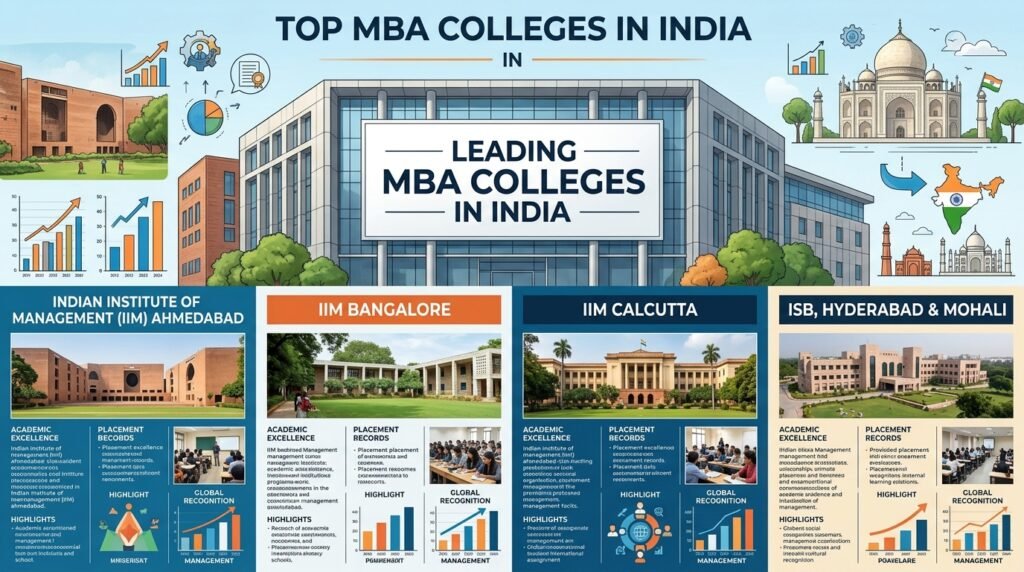

Choosing an MBA college is an important decision because the institute you select can influence your learning experience, professional network, internship opportunities and access to recruiters. However, finding the right college is not simply about choosing the institution with the highest ranking.
The term top MBA colleges in India covers a wide range of management institutes with different admission processes, academic approaches, fees, specializations and career opportunities. Students should therefore compare colleges using several factors, including accreditation and recognition, curriculum, faculty, entrance requirements, total cost, financial support and placement information.
Top MBA Colleges in India
India has many management institutes, including the Indian Institutes of Management (IIMs), management schools at IITs and other established business schools.
One useful reference is the National Institutional Ranking Framework (NIRF) published by the Ministry of Education, Government of India. In the NIRF 2025 Management ranking, IIM Ahmedabad was ranked first, IIM Bangalore second and IIM Kozhikode third. IIT Delhi, IIM Lucknow, IIM Mumbai, IIM Calcutta and IIM Indore also appeared among the top institutions in the ranking.
What Makes an MBA College One of the Best?
Top MBA colleges in India is no single characteristic that makes an MBA college suitable for every student. Academic quality, curriculum, faculty, learning resources, industry exposure, internships, student activities, alumni networks and career opportunities can all contribute to the overall value of a management programme.
Curriculum is particularly important because an MBA should develop an understanding of different areas of business. For example, IIM Bangalore’s PGP includes core subjects covering areas such as accounting, finance, marketing, operations, strategy, economics and organisational behaviour, along with elective courses.
How to Compare Top MBA Colleges in India
A useful comparison should include several categories. First, examine the programme and curriculum. Check whether the courses match your interests and whether the programme offers relevant electives, projects, internships or other practical learning opportunities.
Best MBA Institutes in India
The phrase “best MBA institute” depends partly on the student’s goals. An institute with a strong overall ranking may not necessarily be the best fit for someone looking for a particular specialization or career path.
Top MBA colleges in India NIRF 2025 Management ranking provides a current government-published reference point. It placed IIM Ahmedabad, IIM Bangalore and IIM Kozhikode in the first three positions, followed by IIT Delhi and IIM Lucknow. IIM Mumbai, IIM Calcutta and IIM Indore were also among the leading institutions.
Leading IIMs and Business Schools
The IIMs include some of India’s most prominent management institutions. Their programmes, selection criteria and academic structures are not identical, so applicants should read the admission information for each institute carefully.
For example, IIM Ahmedabad’s PGP admission process for the 2026–28 batch requires a bachelor’s degree with at least 50% marks or equivalent CGPA for general eligibility, with a relaxation to 45% for SC, ST and PwD candidates under the stated criteria. Final-year students can also apply subject to the conditions published by the institute.
Other Well-Known MBA Institutes
Students should not restrict their research to IIMs alone. India’s management education landscape includes IIT management schools, specialised business schools, universities and other institutions.
XLRI, for example, offers several management programmes, including PGDM in Business Management and Human Resource Management, along with programmes in other areas. Its official academic information also highlights the use of case studies and research methods to connect theoretical learning with real-world management challenges. XLRI was ranked 10th in the NIRF 2025 Management category.
Public vs. Private MBA Colleges
Public and private management institutes can differ in their fee structures, governance, resources and programme offerings. However, ownership alone does not determine whether an MBA programme is suitable.
Students should compare recognition, curriculum, faculty, facilities, admission requirements, total costs, scholarships and career outcomes.
MBA Admission Process in India
Top MBA colleges in India is no single admission process that applies to every MBA college in India. Requirements depend on the institution and programme.
For example, IIM Ahmedabad’s domestic MBA admission process uses the Common Admission Test (CAT), followed by an Analytical Writing Test and Personal Interview for shortlisted candidates. The institute states that selection considers the applicable examination score, past academic performance and performance in the later assessment stages.
MBA Eligibility Requirements
MBA eligibility requirements vary between institutions. A bachelor’s degree is a common requirement, but the minimum marks, accepted qualifications, final-year conditions and work-experience requirements can differ.
For IIM Ahmedabad’s PGP 2026–28 batch, the published criteria require a bachelor’s degree with at least 50% marks or equivalent CGPA, with a stated relaxation to 45% for SC, ST and PwD candidates. Eligible final-year students can also apply under the conditions specified by the institute.
This is why applicants should avoid relying on a general statement such as “all MBA colleges require the same percentage.” The official admission criteria of the particular institute should always be checked.
Entrance Exams for MBA Admission
CAT is an important entrance examination for management admissions and is used by the IIMs. IIM Ahmedabad’s current admission information identifies CAT as the examination for domestic applicants to its PGP.
XAT is another major national-level management examination. XLRI states that XAT is conducted by XLRI on behalf of XAMI and that its scores are accepted by more than 250 institutes.
MAT is another management entrance examination administered by the All India Management Association. The appropriate examination depends on the colleges and programmes a student wants to target.
Application and Registration
The application process normally involves registering for the relevant entrance examination and completing any additional institute-level application requirements.
Students should enter academic details accurately, upload required documents, pay applicable fees and save application confirmations. Admission schedules can change between years. For this reason, applicants should use the current examination and institute websites instead of copying deadlines from older articles.
Selection Process and Personal Interview
Admission does not necessarily depend only on the entrance examination score. Institutes can consider academic performance, entrance-test results, interviews and other assessment components. IIM Ahmedabad’s published admission process explicitly includes CAT, Analytical Writing Test and Personal Interview components, along with consideration of past academic performance.
MBA Fees and Scholarships
MBA costs vary considerably across institutions and programmes. Students should calculate the complete cost rather than focusing only on tuition.
For example, IIM Bangalore’s published fee information for its 2026–27 EPGP lists tuition and separate charges such as accommodation, international immersion, refundable deposit and hostel mess for the programme shown on that page.
Tuition Fees at MBA Colleges
Top MBA colleges in India is no single standard tuition fee for an MBA in India. Fees depend on the institution, programme, duration and facilities included. Even within the same institution, different programmes can have different fee structures. Students should therefore compare the official fee document for each programme rather than relying on an average figure from a third-party website.
Scholarships and Financial Support
Some institutions provide scholarships or financial assistance to eligible students. The availability, eligibility requirements and application process vary by institution. Students should check the official scholarship or financial-aid information before assuming that assistance will be available.
Other Costs to Consider
The total cost of an MBA can include more than tuition. Depending on the programme, students may need to account for accommodation, food, deposits, books or course materials, transportation, personal expenses and other campus-related costs.
The official fee information of individual institutions can help students identify additional charges. IIM Bangalore, for example, separately identifies accommodation and other programme-related charges on its published fee pages. A complete budget can help students avoid financial surprises after admission.
MBA Specializations to Consider
An MBA can provide exposure to several areas of business, and students can choose electives or specialised programmes according to their interests. Typical areas include finance, marketing, human resources, operations and business analytics. The exact options depend on the institute and programme.
Top MBA colleges in India students should choose a specialization based on their interests, strengths and intended career direction rather than selecting a subject simply because it appears popular.
Finance and Accounting
Finance-related MBA study can be useful for students interested in corporate finance, banking, investment-related careers, financial analysis and other finance functions.
Before choosing a finance-focused programme, students should examine the finance curriculum, available electives, industry exposure and placement opportunities. A strong academic foundation in accounting and finance can be useful for understanding financial statements, valuation, investment decisions and business performance.
Marketing and Sales
Marketing and sales cover areas such as consumer behaviour, branding, market research, digital channels, pricing and sales management. Students interested in this field should look for programmes that provide opportunities to study marketing strategy, customer behaviour, analytics and sales management.
Career opportunities can include marketing, sales, brand management, business development and related functions, depending on the student’s skills and the recruiting organizations.
Human Resources
Human resources focuses on the management of people within organizations. Areas can include recruitment, talent management, organizational behaviour, employee development, compensation and workplace strategy.
Students particularly interested in HR may consider programmes with strong human-resource curricula. XLRI offers a dedicated PGDM in Human Resource Management among its academic programmes. The choice should be based on the programme’s curriculum, faculty, industry interaction and career opportunities.
Operations and Supply Chain Management
Operations and supply chain management focus on how organizations design, produce, deliver and improve products and services. Relevant areas can include procurement, logistics, production, process management, quality and supply-chain planning. Students interested in this field should compare the operations curriculum and practical learning opportunities offered by different institutes.
Business Analytics
Business analytics combines management education with data-driven decision-making. The area can involve data analysis, statistical methods, forecasting, optimization and the use of technology to support business decisions.
Students considering analytics should check whether the programme includes quantitative courses, analytical tools, practical projects and opportunities to work with real business problems.
Career Opportunities After an MBA

Top MBA colleges in India An MBA can lead to careers across different business functions, but career outcomes are not guaranteed. They depend on the institute, programme, student’s skills, previous experience, specialization and employment market.
Graduates may pursue opportunities in consulting, finance, marketing, sales, operations, technology, product management, analytics, human resources and general management. The exact opportunities available can vary significantly between institutions and admission batches.
Popular MBA Job Roles
Top MBA colleges in India MBA graduates can pursue roles such as management consultant, financial analyst, marketing manager, business development professional, product manager, operations manager, HR professional or business analyst.
However, job titles vary between companies and industries. Students should therefore examine the functions and sectors represented in the placement reports of their target institutes.
Industries Hiring MBA Graduates
Management graduates can work across many industries. Depending on their specialization and recruitment opportunities, they may find roles in consulting, financial services, technology, consumer goods, healthcare, manufacturing, retail, logistics, telecommunications and other sectors.
The breadth of opportunities is one reason why students should investigate actual recruiter and placement information rather than assuming that every MBA college has the same employment profile.
Placement and Career Growth
Top MBA colleges in India Placement reports can help students understand the types of career opportunities associated with a programme. When reviewing a placement report, look beyond the highest salary figure. Check the number of students participating, sectors represented, job functions, recruiters and the way compensation figures are reported.
A strong placement record can provide valuable early-career opportunities, but an MBA does not guarantee a specific salary or career trajectory. Long-term career growth depends on skills, performance, experience, industry conditions and continued professional development.
Entrepreneurship and Business Opportunities
An MBA can also support students who want to pursue entrepreneurship. Management education can provide exposure to subjects such as finance, marketing, operations, strategy and organizational management. These skills can be useful when evaluating a business idea or managing an existing venture.
Students interested in entrepreneurship should also look for institutes with startup activities, entrepreneurship clubs, incubator support, business competitions or opportunities to interact with founders and investors.
How to Choose the Right MBA College
Choosing among the top MBA colleges in India should begin with a clear understanding of your own career goals. Instead of asking only “Which college is number one?”, consider asking whether the programme offers the specialization, learning environment, career opportunities and financial structure that fit your needs.
Rankings and Reputation
Rankings can help students build an initial shortlist. NIRF 2025 ranked IIM Ahmedabad first in Management, followed by IIM Bangalore and IIM Kozhikode. But rankings are published using specific methodologies and can change from one year to another. Students should therefore record the ranking organization and year whenever they cite a ranking.
Reputation within a particular field can also be relevant. Top MBA colleges in India a student interested in HR, analytics or entrepreneurship may want to investigate the strength of that specific area rather than relying only on the overall ranking.
Faculty and Curriculum
The curriculum is one of the most important parts of an MBA. Students should examine core subjects, electives, projects, case studies, internships and experiential-learning opportunities. IIM Bangalore, for example, publishes detailed information about its PGP admission and programme structure. Faculty expertise and research can also help students understand the academic environment they are entering.
Placement Opportunities
Placement information can provide useful evidence about the types of jobs available to graduates. Students should compare sectors, functions, recruiters and reported compensation rather than focusing only on a single maximum package.
It is also useful to check whether the report refers to final placements, summer internships or another type of recruitment activity.
Return on Investment
Return on investment should be considered in a broader sense than simply comparing fees with the highest salary reported by a college. Calculate the total education cost, including tuition and other major expenses. Then consider the range of career opportunities, typical roles, financial support and your own career plans.
Top MBA colleges in India a programme with a higher fee may still make sense for one student, while a lower-cost programme may provide better value for another. The decision should be based on individual circumstances and reliable placement information.
Read more: Techsized com Review: Features, Benefits, and What You Should Know
Tips for Admission to Top MBA Colleges in India
Admission to leading MBA institutes requires preparation well before the application deadline. Students should begin by identifying target colleges, understanding their entrance requirements and preparing for both examinations and later selection stages.
Prepare for Entrance Exams
Top MBA colleges in India start by identifying the entrance examinations accepted by your target institutes. CAT is used in the IIM admission process, while XAT is used for relevant XLRI programmes and is accepted by many other participating business schools.
Once the examination is selected, create a structured preparation plan that includes concept revision, practice questions, mock tests and review of mistakes.
Strengthen Your Academic Profile
Academic performance can form part of an institute’s selection process. IIM Ahmedabad’s published selection process for its PGP includes past academic performance among the components considered during selection.
Top MBA colleges in India students should therefore maintain accurate academic records and understand how their target institutions evaluate academic performance. Applicants should also distinguish between programmes for fresh graduates and programmes designed for experienced professionals because eligibility can be different.
Prepare for Group Discussions and Interviews
Entrance-exam preparation is only one part of the process for many institutes. Shortlisted candidates may have to participate in personal interviews or other assessments. IIM Ahmedabad’s PGP process includes an Analytical Writing Test and Personal Interview after the applicable screening stage. Candidates should be prepared to explain their academic background, career goals, interests and reasons for pursuing an MBA.
Research Colleges Before Applying
Careful research can help students avoid applying to programmes that do not match their goals or eligibility. Before applying, check the official website for:
- Current eligibility criteria
- Accepted entrance examination
- Application dates
- Selection process
- Programme curriculum
- Current fees
- Scholarships and financial aid
- Placement information
Admission rules can change, so information from an older article should not be treated as the final authority.
Final Thoughts
Choosing from the top MBA colleges in India is not simply a matter of finding the highest-ranked institution. A better approach is to compare the factors that matter to your own career: programme quality, curriculum, specialization, admission requirements, total cost, financial aid, placement opportunities and long-term career fit. Rankings such as NIRF can help you create a shortlist, but they should be combined with information from official institute websites and current admission and placement documents.
Choosing an MBA College That Matches Your Career Goals
Before applying, identify the type of career you want to pursue and then find the programmes that support that direction. If your priority is finance, investigate finance coursework and relevant recruiters. If you are interested in HR, compare HR-focused programmes. For analytics, look at quantitative coursework and data-related career opportunities. If entrepreneurship is your goal, investigate the institute’s startup and innovation ecosystem.
FAQs About Top MBA Colleges in India
Which are the top MBA colleges in India?
There is no single universally accepted list because different ranking organizations use different methodologies.
What are the Top MBA colleges in India?
CAT and XAT are two major management entrance examinations. CAT is used in the IIM admission process, while XLRI conducts XAT for its relevant management programmes and the examination score is accepted by many participating business schools.
What are the eligibility requirements for MBA admission?
Eligibility varies by institution. For example, IIM Ahmedabad’s PGP 2026–28 eligibility criteria require a bachelor’s degree with at least 50% marks or equivalent CGPA, with a stated relaxation for SC, ST and PwD candidates.
How much does an MBA typically cost in India?
MBA fees vary widely according to the institute and programme. Top MBA colleges in India have no single fee that applies to all MBA colleges. For example, IIM Bangalore publishes programme-specific fee information that includes tuition and other charges.
What career opportunities are available after an MBA?
MBA graduates can pursue careers in areas such as consulting, finance, marketing, sales, operations, technology, analytics, human resources, product management and general management.