

Corporate social responsibility, commonly called CSR, refers to the responsibility an organization takes for the effects of its decisions and activities on people, society, and the environment. It is broader than charitable donations. CSR can include responsible business practices, human rights, labour conditions, environmental management, consumer interests, ethical conduct, and community development.
There is no single corporate social responsibility strategy that works for every business. The right approach depends on an organization’s size, industry, operations, risks, stakeholders, and impacts. ISO 26000 provides guidance on social responsibility and identifies seven core subjects: organizational governance, human rights, labour practices, the environment, fair operating practices, consumer issues, and community involvement and development.
What Is Corporate Social Responsibility?
Corporate social responsibility is the practice of considering how business decisions affect people and the environment, rather than focusing only on financial or operational results. A responsible business can consider issues such as how employees are treated, whether business partners follow responsible practices, how resources are used, how customers are treated, and how the organization affects its surrounding communities.
The UN Global Compact also connects responsible business with four broad areas: human rights, labour, environment, and anti-corruption. Its Ten Principles provide a widely recognized framework for responsible business conduct. CSR does not require every business to follow an identical program. Organizations should identify the issues most relevant to their activities and stakeholders and address them through appropriate policies and actions.
Why Corporate Social Responsibility Matters for Businesses
Corporate social responsibility matters because business activities can create social, environmental, and economic impacts. Responsible practices help organizations recognize these impacts and make more informed decisions.
For example, a manufacturer may need to consider energy use, waste, worker safety, supply-chain practices, and product impacts. A service company may place greater emphasis on employee practices, customer privacy, accessibility, and ethical business conduct.
Why Corporate Social Responsibility Is Important
Building Customer Trust and Brand Reputation
Customers often receive information about how businesses operate through product information, advertising, company reports, and public statements. Accurate and transparent communication can help customers understand a company’s responsibilities and actions.
However, businesses should not make broad claims that their products or operations are automatically “green,” “eco-friendly,” or socially responsible without appropriate support. The FTC’s Green Guides explain that environmental marketing claims should be truthful and properly substantiated.
Strengthening Employee Engagement
Employees are directly affected by workplace policies and management practices. Responsible employment practices can include fair treatment, non-discrimination, respect for worker rights, appropriate working conditions, and opportunities for development.
The UN Global Compact principles address areas such as freedom of association, collective bargaining, forced labour, child labour, and discrimination in employment.
Supporting Communities and Society
Businesses operate within communities and can affect those communities through employment, purchasing, investment, resource use, and other activities.
Community-focused CSR can include supporting local initiatives, volunteering, partnerships with nonprofit organizations, or programs that address relevant community needs. The most useful initiatives are connected to genuine needs and are managed responsibly rather than created only for publicity.
Key Corporate Social Responsibility Strategies
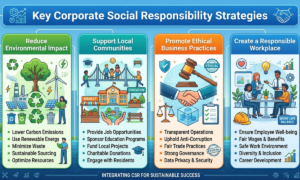
Reduce Environmental Impact
Businesses can examine how their operations affect the environment and identify practical opportunities to reduce negative impacts.
Depending on the organization, this may involve reducing waste, improving energy efficiency, using resources more carefully, reducing unnecessary packaging, or improving environmental management processes. Environmental responsibility is one of the core areas recognized by both ISO 26000 and the UN Global Compact.
Support Local Communities
Businesses can support communities through financial contributions, employee volunteering, partnerships, skills-based support, or other activities that address genuine local priorities.
The appropriate approach depends on the organization’s resources and the needs of the community. A small business may contribute time or professional skills, while a larger organization may have the capacity for broader programs.
Promote Ethical Business Practices
Ethical business practices are an important part of corporate social responsibility. They can include transparent decision-making, responsible marketing, anti-corruption measures, respect for human rights, and appropriate treatment of customers and business partners. The UN Global Compact specifically calls on businesses to work against corruption, including bribery and extortion.
Create a Responsible Workplace
A responsible workplace should consider employee rights, fair treatment, safety, inclusion, and appropriate working conditions. CSR should not be limited to external donations while ignoring internal employment practices. Responsible workplace policies are part of the organization’s broader social responsibility.
Environmental Corporate Social Responsibility Strategies
Reduce Waste and Energy Consumption
Businesses can review where waste and unnecessary energy use occur within their operations. Practical actions may include improving equipment efficiency, reducing unnecessary printing, managing materials more carefully, and establishing appropriate waste-reduction procedures. The specific measures should reflect the organization’s actual operations rather than relying on generic sustainability claims.
Use Resources More Responsibly
Responsible resource use involves understanding how materials, water, energy, and other resources are consumed and where improvements can be made. Businesses can establish procedures for monitoring resource use and identify areas where consumption or waste can reasonably be reduced.
Set Practical Sustainability Goals
Environmental goals should be specific enough to monitor. Instead of making vague commitments, a company can establish measurable objectives related to areas such as energy use, waste, water consumption, or material efficiency. Goals should also be realistic and connected to the organization’s actual environmental impacts.
Community-Focused Corporate Social Responsibility Strategies
Support Local Community Initiatives
Businesses can identify community issues that are relevant to their location and operations. Support may include funding, resources, professional expertise, or employee participation. A useful community program should have a clear purpose and should not claim results that cannot be demonstrated.
Encourage Employee Volunteering
Employee volunteering can give workers opportunities to contribute time and skills to community activities. Companies can support volunteering by providing appropriate policies, organizing activities, or partnering with community organizations. Participation should be handled in a way that respects employees’ choices and workplace responsibilities.
Partner With Nonprofit Organizations
Nonprofit organizations can provide knowledge and experience in specific community areas. Businesses may work with these organizations through donations, volunteering, technical assistance, or longer-term partnerships. Before entering a partnership, businesses should understand the organization’s purpose, activities, and ability to use resources responsibly.
Ethical Business Strategies for CSR
Promote Fair and Transparent Practices
Businesses should communicate important information accurately and avoid practices that could mislead customers, employees, investors, or other stakeholders. Transparency also means acknowledging limitations. A company does not need to claim perfection to demonstrate responsibility; it should communicate what it is doing and provide support for important claims.
Maintain Responsible Supply Chains
A company’s social and environmental impacts can extend beyond its direct operations into its supply chains and other business relationships. The OECD recommends risk-based due diligence to help businesses identify, prevent, mitigate, and address actual or potential adverse impacts in their operations, supply chains, and business relationships. This makes supply-chain responsibility an important part of corporate social responsibility for many businesses.
Protect Customer and Stakeholder Interests
Responsible businesses should consider the interests and rights of people affected by their activities. Depending on the organization, this can involve product information, responsible marketing, privacy, accessibility, safety, complaint handling, and other relevant consumer or stakeholder issues.
Employee-Focused Corporate Social Responsibility Strategies
Promote Workplace Equality and Inclusion
Businesses should provide fair employment practices and avoid unlawful discrimination. The UN Global Compact includes the elimination of discrimination in employment and occupation among its labour principles. Companies can support responsible workplaces through clear policies, fair procedures, appropriate training, and mechanisms for addressing workplace concerns.
Support Employee Well-Being
Employee well-being can be addressed through appropriate working conditions, workplace safety, reasonable policies, and access to support that fits the organization’s circumstances. The exact approach will differ by industry and location, but responsible employment should remain part of the organization’s broader CSR approach.
Provide Learning and Development Opportunities
Training and development can help employees build skills relevant to their roles and future responsibilities. Businesses can identify skill needs, provide appropriate learning opportunities, and evaluate whether training supports organizational and employee objectives.
How to Develop a Corporate Social Responsibility Strategy
Identify Business and Social Priorities
Start by identifying the organization’s most significant social and environmental issues. Businesses should consider their operations, products, employees, supply chains, customers, communities, and other relevant stakeholders. ISO 26000 specifically includes stakeholder identification and engagement as part of implementing social responsibility.
Set Clear and Measurable CSR Goals
Once priorities are identified, businesses can establish goals that are specific and measurable. For example, instead of simply stating that the company wants to “be more sustainable,” it can define a measurable objective related to a particular environmental or social impact.
Involve Employees and Stakeholders
CSR works better when relevant people understand their roles and have appropriate opportunities to contribute. Stakeholder engagement can help an organization understand concerns, identify priorities, and improve its approach. ISO 26000 specifically provides guidance on identifying and engaging stakeholders.
Monitor and Improve CSR Initiatives
CSR should be treated as an ongoing process rather than a one-time campaign. Businesses can review results, identify weaknesses, update goals, and improve programs over time. This allows organizations to respond to changing circumstances and better understand their actual impacts.
How to Measure Corporate Social Responsibility Efforts
Track Social and Environmental Outcomes
Measurement should focus on meaningful outcomes rather than simply counting activities. For example, a business may track relevant changes in resource use, waste, employee-related measures, community program outcomes, or supply-chain due-diligence activities. The appropriate indicators depend on the organization’s material impacts.
Collect Stakeholder Feedback
Feedback from employees, customers, communities, suppliers, and other relevant stakeholders can provide information that internal measurements may miss. Feedback should be collected through suitable methods and used to identify areas for improvement.
Report CSR Progress Transparently
Businesses can communicate their CSR activities, progress, limitations, and relevant results through appropriate reports or other public communications. The GRI Standards are designed to help organizations report their impacts on the economy, environment, and people in a comparable and credible way. Transparent reporting should distinguish between what has been achieved, what remains in progress, and what the organization plans to do next.
Common Corporate Social Responsibility Challenges
Managing CSR Costs and Resources
CSR programs require appropriate resources. Businesses may need to allocate employee time, management attention, technology, training, or financial resources. The solution is not necessarily to create a large program. Organizations can prioritize the issues where they have significant impacts and where practical improvements are possible.
Measuring the Impact of CSR Programs
Some social and environmental outcomes are more difficult to measure than financial or operational results. Businesses should therefore select indicators that relate directly to their objectives and avoid presenting activity counts as proof of broader impact.
Avoiding Misleading or Unsupported CSR Claims
A major CSR challenge is communicating responsibly. Companies should not exaggerate their environmental or social performance. For environmental marketing in particular, FTC guidance states that broad, unqualified claims such as “green” or “eco-friendly” can be difficult to substantiate and should be appropriately qualified.
Read more : VCGamers: Everything You Need to Know About the Gaming Marketplace
Examples of Corporate Social Responsibility Strategies
Environmental Responsibility Examples
An organization might reduce operational waste, monitor energy consumption, improve resource efficiency, or establish measurable environmental objectives. The appropriate strategy depends on the company’s activities and environmental impacts.
Community Support Examples
A business might support a local nonprofit, provide employee volunteering opportunities, contribute relevant professional skills, or fund a community initiative. The strongest examples are connected to genuine community needs and have clear objectives.
Employee Responsibility Examples
Employee-focused CSR can include fair employment practices, non-discrimination policies, workplace safety measures, employee development, and appropriate opportunities for participation in company initiatives. These practices demonstrate that corporate social responsibility can be integrated into normal business operations rather than treated only as external philanthropy.
Final Thoughts
Corporate social responsibility is most effective when it is connected to everyday business decisions rather than treated as a separate publicity exercise. A practical approach begins with identifying the organization’s most important impacts, understanding stakeholder expectations, setting measurable goals, implementing appropriate policies, monitoring results, and communicating progress accurately.
Recognized frameworks such as ISO 26000, the UN Global Compact, OECD responsible-business guidance, and GRI can provide useful structures for organizations developing or improving their approach. The most important principle is simple: corporate social responsibility should be based on genuine action, responsible decision-making, and honest communication. When CSR becomes part of how a business operates, it can provide a structured way to address its responsibilities to people, society, and the environment.
FAQs About Corporate Social Responsibility
What Is Corporate Social Responsibility in Simple Terms?
Corporate social responsibility means taking responsibility for how a business affects people, society, and the environment. It can include responsible treatment of employees, customers, suppliers, communities, and the environment.
What Are the Main Types of Corporate Social Responsibility?
There is no single universally required list of CSR types. ISO 26000 provides seven core subjects: organizational governance, human rights, labour practices, the environment, fair operating practices, consumer issues, and community involvement and development.
Why Should a Business Have a CSR Strategy?
A CSR strategy helps a business identify and manage relevant social and environmental responsibilities in a more organized way. It can also help the organization communicate its commitments and monitor progress.
How Can Small Businesses Implement Corporate Social Responsibility?
Small businesses can begin with issues that are directly connected to their operations. Examples include responsible employment practices, reducing avoidable waste, treating customers fairly, supporting relevant community activities, and working responsibly with suppliers.
How Can Businesses Measure the Success of CSR Strategies?
Businesses can measure CSR by tracking indicators connected to their specific goals and impacts. These may include environmental measures, employee-related indicators, supply-chain due diligence, community outcomes, or stakeholder feedback.