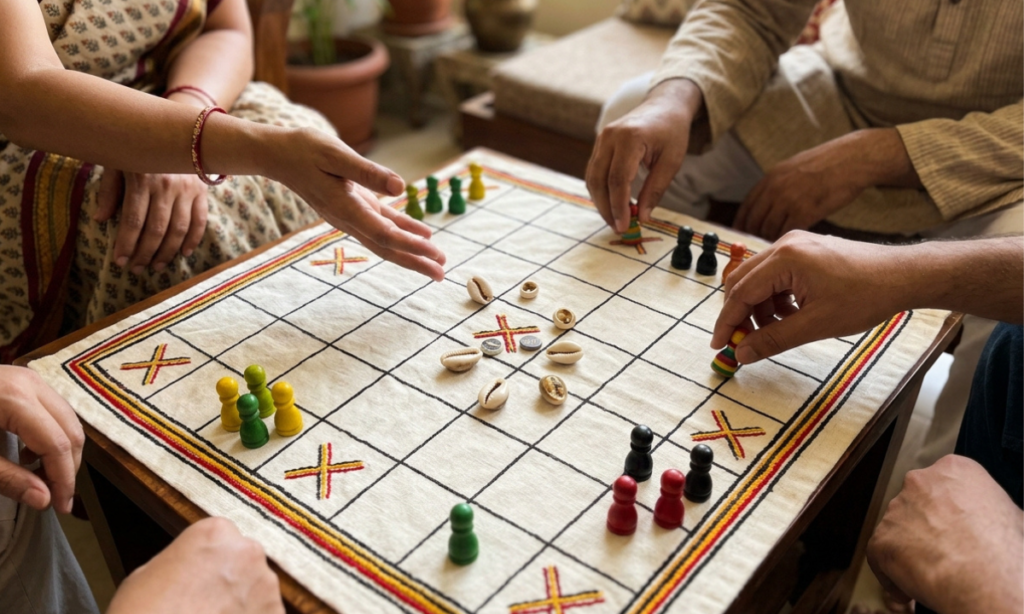

Traditional board games have a special place in Indian culture, and the Ashta Chamma game is one example that continues to attract interest because of its simple equipment and combination of luck and strategy. It is a race-and-capture game traditionally played with cowrie shells and playing pieces.
Ashta Chamma is particularly associated with the Telugu-speaking regions of southern India. Related versions are known by different names in other parts of India, including Chowka Bara or Chowka Bhara in Karnataka. Because these regional versions can have different boards and rules, the exact way the game is played may vary.
At its core, the idea is simple: players move their pieces along a designated route, try to capture opposing pieces, and attempt to bring all of their pieces safely to the central home area.
What Is Ashta Chamma Game?
Meaning and Basic Overview
The Ashta Chamma game is a traditional Indian board game based on movement, capturing, chance, and decision-making. Players use cowrie shells as a traditional alternative to dice. The result of the shell throw determines how many spaces a player can move.
A commonly documented version uses four cowrie shells. One, two, three, or four shells landing mouth-up can produce corresponding movement values. When all four shells land in the opposite orientation, the result is known as Ashta and has a value of eight. A result of four is known as Chamma. In this commonly documented ruleset, Ashta and Chamma also provide an additional throw.
Objective of the Game
The main objective is to move all of your playing pieces around the required route and eventually bring them into the central home or finishing area.
Capturing opposing pieces is another important part of the game. If a piece lands on an opponent’s piece on a capturable square, the opposing piece may be sent back to its starting area.
Number of Players and Game Duration
Traditional descriptions commonly present Ashta Chamma as a game for two to four players, although the exact player arrangement can differ between versions.
Game length is not fixed. Ashta Chamma game depends on the number of players, the movement results, captures, and the rules being used. A game can therefore be relatively short or continue for considerably longer when players repeatedly capture pieces or receive bonus turns.
History and Origins of Ashta Chamma
Traditional Roots of the Game
Ashta Chamma belongs to a broader family of traditional Indian race games that includes related forms such as Chowka Bara and other regional cowrie-shell games. Its exact historical age and single point of origin are not firmly established. Ashta Chamma game is more accurate to describe Ashta Chamma as part of a long Indian tradition of race-and-capture board games rather than claiming a precise invention date.
The game was traditionally simple to set up. Boards could be drawn on cloth or on the ground, while cowrie shells and everyday objects could be used for the playing equipment. This made the game accessible without requiring a commercially manufactured board.
Cultural Importance of Ashta Chamma
The cultural importance of Ashta Chamma comes partly from Ashta Chamma game connection with traditional household and community entertainment. Games of this type could bring people together while also requiring players to count, plan movements, watch opponents, and make decisions.
The game is also interesting because related versions appear under different regional names. This shows how traditional board games can change as they move between communities while retaining similar core ideas.
Ashta Chamma Game Board and Pieces
Understanding the Board Layout
There is no single board design that represents every version of the Ashta Chamma game. One commonly documented modern reconstruction uses a 7-by-7 grid with concentric routes leading toward a central home space. Other versions and regional forms use different board designs, including smaller boards.
The important feature is the playing route. Pieces generally travel around the board and progressively move toward the central finishing area. Some boards also contain specially marked safe spaces. A piece on one of these spaces cannot normally be captured under the rules of that version.
Tokens, Dice, and Other Components
Traditional Ashta Chamma uses:
- A playing board
- Four playing pieces for each player in a commonly documented version
- Four cowrie shells
- A designated starting area for each player
Cowrie shells are particularly important because they provide the movement result without requiring a conventional die.
Starting Position of the Pieces
Players normally begin with their pieces outside the main movement route or in a designated starting area. In one widely documented ruleset, a player needs a result of 1 or 8 to bring a piece onto the board. Other traditional versions use different entry conditions, so the rules of the particular board should be checked before beginning. This is one of the areas where regional versions of the game can differ.
How to Play Ashta Chamma Game
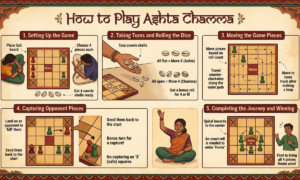
Setting Up the Game
First, players choose their playing pieces and identify their starting areas. The cowrie shells are placed where they can be easily thrown and retrieved. Players should also agree on the rules being used, especially if they come from different regions or have learned different versions of the game. Once the board and pieces are ready, players decide who takes the first turn.
Taking Turns and Rolling the Dice
Traditional play uses four cowrie shells rather than a standard six-sided die. The shells are thrown together, and the number of shells landing in the designated orientation determines the movement value. A commonly documented system produces values of 1, 2, 3, 4, or 8.
The special values are:
- Chamma = 4
- Ashta = 8
In the commonly documented ruleset, rolling a Chamma or Ashta gives the player another throw.
Moving the Game Pieces
After determining the movement value, the player chooses an eligible piece and moves it along the appropriate route. This is where the strategic side of the Ashta Chamma game becomes important. A player may have several pieces available, and choosing the right one can affect future opportunities.
Capturing Opponent Pieces
Capturing is one of the most recognizable features of the game. When a player’s piece lands on an opponent’s piece on a square where capturing is allowed, the opponent’s piece is generally sent back to its starting area.
Safe squares provide an important exception. A piece occupying a marked safe square is protected from capture in rulesets that use those spaces. Some versions also reward a successful capture with an additional turn.
Completing the Journey and Winning
The ultimate goal is to move each piece through the required route and reach the central home area. In a commonly documented four-piece version, the first player to get all four pieces into the center wins.
Some versions require an exact movement to enter the final home position. Because this rule is not universal, players should follow the instructions for their particular version.
Ashta Chamma Game Rules Explained
Basic Movement Rules
The basic movement system is based on the cowrie-shell result. A typical four-shell system works like this:
- 1 shell in the designated orientation = move 1 space
- 2 shells = move 2 spaces
- 3 shells = move 3 spaces
- 4 shells = Chamma, move 4 spaces
- 0 shells = Ashta, move 8 spaces
Ashta and Chamma commonly provide an additional throw. These rules describe a commonly documented version rather than every regional form of Ashta Chamma.
Capturing and Safe Spaces
A player normally captures an opposing piece by landing directly on its position when that position is not protected. The captured piece is returned to Ashta Chamma game starting area and must make its way around the board again.
Marked safe spaces cannot normally be used for capturing. These spaces give players an opportunity to protect vulnerable pieces from opponents.
Special Movement Rules
Special movement rules are one reason Ashta Chamma can feel different from ordinary dice-based race games.
The two best-known special results are Ashta and Chamma. They have movement values of eight and four respectively in the commonly documented ruleset and can provide bonus throws.
Some regional versions also have additional rules concerning entering pieces, capturing, finishing, or repeated special throws. Therefore, Ashta Chamma game is useful to establish the house or regional rules before playing.
Winning Conditions
The basic winning condition is straightforward: get all of your pieces to the final home area before your opponents. In versions requiring an exact final movement, a player must receive the appropriate movement value to place a piece into the central home. The first player to complete the required journey with all pieces is the winner.
Ashta Chamma Game Strategy and Tips
Planning Your Moves
The shell result is based on chance, but players still make important decisions. When more than one piece can move, consider the position of your entire set rather than automatically moving the piece that is closest to home.
A balanced position can give you more choices on later turns and may reduce the danger of having all your progress concentrated in one exposed piece.
When to Take Risks
Capturing an opponent can be valuable, but a capture is not always the only useful move. Before taking a risky position, consider where your opponent’s pieces are and whether your own piece could become vulnerable on the following turn.
A good move is not necessarily the one that advances the greatest distance. Sometimes positioning a piece safely can be more useful.
Protecting Your Pieces
Safe spaces are especially important because they can protect pieces from capture. Players should also pay attention to how close an opponent’s piece is to their own. A piece that appears to be making excellent progress can lose that advantage if Ashta Chamma game is left in a vulnerable position.
Common Mistakes Beginners Should Avoid
Beginners often focus only on moving the piece that is closest to the center. That can overlook opportunities to develop other pieces or avoid capture. Another mistake is assuming that Ashta Chamma follows exactly the same rules as Ludo. Although both are race-style board games, their traditional movement systems and equipment are different.
New players should also avoid assuming that every Ashta Chamma board follows identical rules. Regional variations are an important part of the game’s history.
Why Is Ashta Chamma Game Still Popular?
Family and Social Entertainment
The Ashta Chamma game requires relatively simple equipment and can be played around a shared board. This makes it naturally suited to family and social settings. Traditional versions could be played with simple boards and readily available objects, making the game accessible without expensive equipment.
The combination of competition and conversation also gives the game a social quality that many traditional board games share.
Skill, Luck, and Decision-Making
Ashta Chamma combines chance and decision-making. The cowrie shells determine the movement opportunity, but players decide how to use that opportunity. They have to consider which piece to move, whether to pursue a capture, whether to protect a piece, and how to progress toward the center. This combination is what gives the game more depth than a purely random race.
Traditional Game in the Modern Era
Ashta Chamma has also found a place in digital gaming. Modern mobile versions can reproduce cowrie-shell throws, token movement, captures, safe spaces, and home areas. Some digital adaptations offer local multiplayer, online play, computer-controlled opponents, and multiple board configurations.
These adaptations allow players to experience the basic concept of the traditional game even when they do not have a physical board and cowrie shells.
Ashta Chamma vs. Similar Traditional Board Games
Ashta Chamma and Pachisi
Ashta Chamma and Pachisi belong to the broader family of Indian race-and-capture games, so they share several basic concepts. Both involve moving pieces around a board, using chance to determine movement, interacting with opponents, and attempting to reach a final destination.
Key Similarities and Differences
The similarities include:
- Race-style movement
- Chance-based movement
- Multiple playing pieces
- Capturing in relevant spaces
- A final destination or home area
- A mixture of luck and player decisions
The differences can include the board design, number of shells or dice used, movement values, entry requirements, safe spaces, and rules for reaching the center.
Read more : VCGamers: Everything You Need to Know About the Gaming Marketplace
Can You Play Ashta Chamma Game Online?
Digital and Mobile Versions
Yes. Digital versions of the Ashta Chamma game are available for modern devices. These versions can recreate traditional elements such as cowrie-shell throws, token movement, captures, safe spaces, and central home areas.
Some current mobile adaptations also provide features such as local multiplayer, online multiplayer, computer-controlled opponents, and different board sizes. However, digital games may introduce their own rules, so players should read the rules within the individual game before assuming it follows a particular traditional version.
Traditional Board Game vs. Online Version
The biggest difference is the way the game is presented. A physical game uses real pieces and cowrie shells, while a digital version handles the shell results and movement electronically.
A traditional board can provide a more hands-on experience and preserve the physical character of the game. An online or mobile version is more convenient when players do not have access to the physical equipment. Both formats can introduce people to the core ideas of Ashta Chamma.
Final Thoughts on Ashta Chamma Game
The Ashta Chamma game is a traditional Indian race-and-capture board game that combines simple equipment with meaningful player decisions. Cowrie shells provide the element of chance, while movement choices, captures, safe spaces, and positioning give players opportunities to think ahead.
One important thing to remember is that Ashta Chamma does not have one universally identical rulebook. Regional traditions and modern adaptations can differ in board design, token entry, movement, capturing, and finishing rules. Understanding this variation makes it easier to appreciate the game accurately rather than assuming that every version is played in exactly the same way.
FAQs About Ashta Chamma Game
Is Ashta Chamma Game easy to learn?
Yes, the basic rules are fairly simple: determine a movement value, move a piece, and try to reach the home area. The game becomes more strategic as players learn about captures, safe spaces, and different regional rules.
How many players can play Ashta Chamma?
Ashta Chamma is commonly played by two to four players, depending on the version being used. Modern digital versions may offer additional player options or different multiplayer modes.
What equipment is needed to play the game?
A traditional setup generally includes a game board, playing pieces, and four cowrie shells for determining movement. Simple objects such as stones or seeds can also be used as playing pieces in informal versions.
Is Ashta Chamma based on luck or strategy?
Ashta Chamma combines luck and strategy, because the cowrie-shell result determines the available movement. Players then decide which piece to move, when to capture, and how to protect their pieces.
How do you win an Ashta Chamma game?
In a commonly documented version, the winner is the first player to move all four pieces through the required route to the central home area. Some versions use additional finishing rules, so the exact winning condition can vary between regional rule sets.