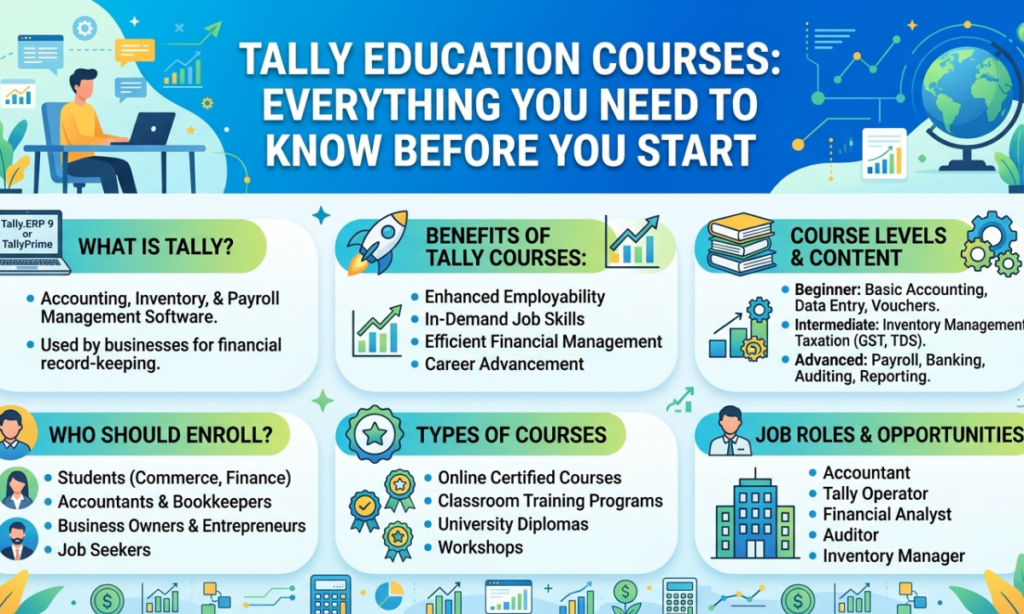

Learning accounting software can be a useful step for students, beginners, business owners, and professionals who want to understand computerized accounting. Tally education focuses on developing practical knowledge of TallyPrime and related accounting processes, including transaction recording, accounts management, inventory, taxation, payroll, banking, and financial reporting.
The right course, however, depends on your current knowledge and what you want to achieve. Some learners may need basic TallyPrime training, while others may be looking for specialized knowledge in GST, payroll, or advanced Tally-related areas.
Before choosing a course, it is worth understanding what Tally education includes, what you can learn, how courses differ, and how to select training that matches your goals.
What Are Tally Education Courses?
Tally education refers to structured learning that helps people develop computerized accounting skills using Tally software, particularly TallyPrime. The learning process can involve recording business transactions, maintaining accounts, managing inventory, handling taxation-related information, working with payroll, and generating financial reports.
Tally Education currently provides different learning options, including self-paced online courses and classroom-based programs. Its course range includes subjects such as TallyPrime basics, GST, payroll, and other specialized areas.
The purpose of tally education is not simply to memorize software commands. A good learning program should help students understand how accounting information is entered, processed, checked, and presented through accounting software.
What Tally Courses Are Designed to Teach
The subjects covered depend on the particular course. Basic programs may concentrate on transaction recording, account management, receivables, payables, and banking-related activities.
More specialized programs can introduce areas such as GST, payroll, taxation, data analysis, reporting, or TallyPrime customization.
Who Should Consider Learning Tally?
Tally education can be useful for people interested in accounting, bookkeeping, finance, taxation, administration, or business operations.
Students may use it to develop practical software knowledge alongside their academic studies. Beginners can use introductory courses to build foundational skills, while working professionals may choose specialized training to strengthen particular areas.
Why Choose Tally Education Courses?
Benefits of Learning Tally
One of the main benefits of Tally education is the opportunity to practice accounting processes in a computerized environment.
Instead of working only with theoretical examples, learners can practice entering transactions and examining the resulting accounting information. TallyPrime supports accounting and financial reporting, banking activities, inventory management, payroll, and statutory compliance features.
Building Practical Accounting Skills
Accounting knowledge becomes more useful when learners know how to apply it to actual transactions. Through practical Tally education, students can learn how transactions are recorded and how those entries affect accounts and reports. Depending on the course, practical exercises may involve sales, purchases, receipts, payments, expenses, receivables, payables, and bank reconciliation.
Improving Computerized Accounting Knowledge
Computerized accounting requires more than knowing accounting terminology. Learners also need to understand how accounting software organizes information.
TallyPrime provides tools for creating accounts, recording transactions, managing financial information, reconciling banking transactions, and generating reports.
Learning these functions can help students become more comfortable with digital accounting workflows while developing a better understanding of how accounting data is managed electronically.
Types of Tally Education Courses
Basic Tally Courses for Beginners
Basic courses are generally the most appropriate starting point for someone with little or no experience using TallyPrime. Tally Education currently offers a TallyPrime Basics course covering areas such as transaction recording, bill-wise accounts, receivables and payables, cheque management, and bank reconciliation.
Intermediate Tally Courses
Intermediate training can introduce broader accounting and business processes after the learner understands the basics. Depending on the program, this level may include inventory management, taxation, reporting, banking, receivables, payables, or more detailed accounting workflows.
There is no universal definition of an “intermediate” Tally course, so students should always examine the actual curriculum before enrolling.
Advanced Tally Courses
Advanced programs are generally intended for learners who already understand the fundamentals and want to develop more specialized skills.
Examples can include advanced GST-related learning, payroll, data analysis, or Tally Definition Language (TDL). TDL training is particularly different from ordinary accounting training because it focuses on customization and development capabilities within the Tally environment.
Online and Classroom Tally Courses
Tally education is available through different learning formats. Online courses can provide flexibility for learners who prefer studying independently. Classroom-based courses can be useful for students who prefer direct instruction and face-to-face practical training.
Neither format is automatically better for everyone. Consider your schedule, learning preferences, access to practice facilities, and the amount of instructor support you want before choosing.
What Do You Learn in Tally Education Courses?
Accounting and Bookkeeping Fundamentals
Accounting fundamentals are an important foundation for Tally learning. Depending on the course, learners may study accounts, ledgers, journals, vouchers, receivables, payables, banking transactions, and financial reports.
Understanding these concepts helps learners recognize why transactions are recorded in particular accounts instead of simply following software instructions without understanding their purpose.
Creating Companies and Recording Transactions
One of the fundamental practical activities in TallyPrime is creating and configuring a company before recording its transactions. Learners can practice entering common business transactions and then examine how those transactions affect accounting records. This gives beginners an opportunity to understand the connection between individual entries and the larger accounting system.
GST and Tax-Related Accounting
GST can be an important part of Tally education for learners working with businesses subject to India’s GST system. TallyPrime provides GST-related functionality for configuring GST details, recording relevant transactions, preparing GST reports, and supporting various compliance workflows. Tally Education also offers dedicated courses covering GST and TallyPrime.
Inventory Management
Businesses that purchase, sell, store, or manufacture goods often need to manage inventory alongside their accounts. TallyPrime includes inventory features such as stock groups, stock categories, units of measurement, batches, locations, reorder levels, and stock valuation. Learning these functions can help students understand how inventory information can be maintained alongside financial records.
Payroll Management
Payroll is another area that can be covered in Tally-related learning. TallyPrime provides payroll features for managing employee-related information, salary processing, attendance, payments, and applicable statutory processes.
Learners interested in accounting or administrative roles may find payroll knowledge useful as an additional computerized business skill.
Financial Reports and Statements
Entering transactions is only part of accounting. Understanding the resulting reports is equally important. TallyPrime can generate reports such as the Balance Sheet, Profit and Loss Account, receivables and payables information, cash-flow information, and other business reports.
Learning how to generate and understand these reports can help students see how individual transactions contribute to a company’s overall financial information.
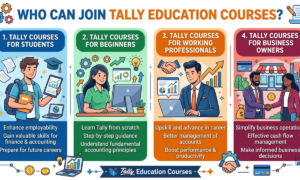
Who Can Join Tally Education Courses?
Tally Courses for Students
Students studying commerce, accounting, finance, business, or related subjects can use Tally education to develop practical software skills.
Learning TallyPrime alongside academic accounting can help students understand how accounting concepts are applied in computerized business environments.
A beginner-level program can be a sensible starting point for students who have limited experience with accounting software.
Tally Courses for Beginners
Beginners can start with foundational Tally education without first becoming experts in accounting software. A suitable beginner course should explain basic accounting concepts, company setup, transaction recording, and essential reports in a structured manner. Starting with the fundamentals can make it easier to progress toward GST, inventory, payroll, or other specialized areas later.
Tally Courses for Working Professionals
Working professionals may choose Tally education to improve existing accounting skills or learn additional software functions. For example, someone already working with bookkeeping may want to learn more about GST, reconciliation, reporting, inventory, or payroll.
Tally Courses for Business Owners
Business owners may also benefit from understanding computerized accounting and business records.
TallyPrime can be used for accounting, invoicing, inventory, banking, payroll, and reporting. Understanding these functions can give business owners greater familiarity with the information maintained in their accounting system.
How Long Does It Take to Complete a Tally Course?
Short-Term Tally Courses
There is no single duration for every Tally course. The amount of time required depends on the course syllabus, level, learning format, practical requirements, and the learner’s previous accounting knowledge. Some introductory programs are designed as relatively focused courses, while broader certification programs cover more subjects and require additional study.
Advanced and Certificate Programs
Certification programs can have their own learning requirements, assessments, and completion conditions. For example, some Tally Education courses provide certificates after learners complete the required course modules, while other specialized programs include assessments that must be passed to receive certification.
Factors That Affect Course Duration
Your learning speed can depend on several factors. Previous accounting experience, familiarity with computers, daily practice time, course complexity, and the amount of practical training can all influence how quickly you become comfortable with TallyPrime.
Someone with accounting experience may find the software easier to understand, while a complete beginner may need additional time to learn both accounting concepts and software procedures.
How to Choose the Right Tally Education Course
Check the Course Curriculum
Always read the syllabus before enrolling. Look for specific topics that match your goals. If you want basic accounting skills, an introductory course may be sufficient. If you need GST, payroll, inventory, or advanced functionality, choose a program that clearly includes those subjects.
Look for Practical Training
Practical training is particularly important when learning accounting software. Look for exercises, business scenarios, demonstrations, or lab practice that allow you to apply what you learn. A course that combines explanations with hands-on practice can give you a better opportunity to understand how accounting software is used in real situations.
Compare Learning Formats
Consider whether you learn better independently or with an instructor. Online courses can offer flexibility, while classroom courses can provide direct interaction and structured learning. Also consider whether the course provides access to practice environments, learning materials, assessments, or instructor support.
Consider Certification and Support
If you want a certificate, check who issues it and what requirements you must complete. Tally Education provides digital certificates for eligible courses and has a certificate-verification facility. However, certification requirements vary between programs.
What Skills Can You Gain From Tally Education?
Accounting and Bookkeeping Skills
Tally education can help learners practice computerized accounting tasks such as maintaining accounts, recording transactions, managing receivables and payables, and working with financial reports. The exact level of skill depends on the course and how much practical work the learner completes.
Financial Management Skills
Working with accounting information can introduce learners to areas such as cash flow, receivables, payables, banking transactions, and financial reporting. TallyPrime provides features that support these areas, allowing learners to practice working with financial information in a structured digital environment.
GST and Taxation Skills
Specialized Tally education can introduce learners to GST-related processes and reporting within TallyPrime. This can be useful for understanding how tax information is recorded and processed in accounting software.
However, software training should not be confused with professional tax advice. Actual compliance should always follow current laws and official requirements.
Data Entry and Record-Keeping Skills
Accurate transaction entry is fundamental to computerized accounting. Learners can develop better record-keeping habits by practicing how to enter transactions correctly, organize accounts, and review information for errors.
Reporting and Business Analysis Skills
TallyPrime provides various accounting, financial, inventory, and business reports. Learning how to generate and review these reports can help learners understand the information created from recorded transactions. This moves the learning process beyond simple data entry and toward understanding how accounting information can be reviewed and used.
Career Opportunities After Tally Education
Accounting Assistant Roles
Tally skills can complement entry-level accounting knowledge and may be relevant to accounting assistant positions where computerized accounting software is used. However, completing a Tally course does not guarantee employment. Employers may have different requirements involving education, accounting knowledge, software experience, and practical skills.
Accounts Executive Opportunities
People with accounting knowledge and TallyPrime experience may pursue accounting-related positions involving transaction recording, invoicing, reconciliation, reporting, or other financial tasks. The responsibilities of an accounts executive vary considerably between organizations, so candidates should review individual job descriptions carefully.
Bookkeeping Careers
Bookkeeping is another area where computerized accounting knowledge can be useful. A learner who understands both bookkeeping principles and TallyPrime can develop a more practical skill set than someone who knows only the software. Actual job requirements vary, and additional qualifications or experience may be necessary for particular positions.
Payroll and Finance-Related Roles
TallyPrime includes payroll functionality, making payroll knowledge another potential area of specialization.
Learners can study employee information, salary processing, attendance, and related payroll processes depending on the course they choose. This can complement broader accounting and administrative skills.
Freelancing and Small Business Opportunities
People with appropriate accounting knowledge may use computerized accounting skills when supporting small businesses or providing bookkeeping-related services.
However, anyone offering professional accounting or tax services should understand and follow the legal and professional requirements that apply in their location. TallyPrime can support accounting, invoicing, inventory, payroll, banking, and reporting, but the software itself does not determine whether an individual is qualified to provide professional services.
How to Learn Tally Effectively
Start With Accounting Basics
If you are completely new to accounting, start with the fundamentals. Learn concepts such as accounts, transactions, ledgers, journals, income, expenses, assets, liabilities, receivables, and payables before trying to memorize advanced software functions. Once you understand the accounting logic, TallyPrime becomes easier to use because you can understand the purpose behind each transaction.
Practice With Realistic Transactions
Regular practice is one of the best ways to develop confidence. Instead of repeating the same simple example, create realistic scenarios involving purchases, sales, expenses, receipts, payments, customers, suppliers, and bank transactions. Try to complete an entire accounting cycle and then review the resulting reports.
Work With Financial Reports
Do not treat reports as something to study only at the end of a course. After recording transactions, examine the relevant reports and consider whether the results make sense.
TallyPrime provides multiple accounting and financial reports, giving learners an opportunity to understand how recorded transactions are reflected in financial information.
Keep Your Tally Knowledge Updated
Accounting software continues to develop, and tax and compliance requirements can also change. Use current TallyPrime documentation and current official tax information when learning or working with real accounting records.
Keeping your knowledge updated is particularly important when dealing with taxation and statutory compliance.
Read more : Furtherbusiness com: Everything You Need to Know About the Website
Common Mistakes to Avoid When Choosing a Tally Course
Choosing a Course Without Checking the Syllabus
A course title alone does not tell you everything about its content. Read the syllabus carefully and confirm that it covers the areas you actually want to learn. If your goal is GST, for example, choose a program that specifically includes relevant GST topics rather than assuming they are included in every basic Tally course.
Focusing Only on Theory
Accounting concepts are important, but TallyPrime is practical software. A learner who studies only theory may understand accounting terminology but still struggle when asked to create accounts or record actual transactions. Choose learning that combines explanations with practical application.
Ignoring Practical Accounting Practice
Simply watching videos or reading instructions may not be enough to build confidence. Spend time creating sample companies, entering transactions, checking ledgers, reconciling information, and reviewing reports. Practice helps turn theoretical knowledge into usable skills.
Selecting a Course Based Only on Price
Price should not be the only factor in your decision. Compare the syllabus, practical training, learning format, instructor support, certification, course access, assessments, and other included features. A course that closely matches your goals may be more valuable than simply choosing the cheapest option.
Final Thoughts on Tally Education Courses
Tally education can be a practical starting point for anyone who wants to develop computerized accounting skills. From basic transaction recording to inventory, GST, payroll, banking, and financial reporting, the learning possibilities depend on the course and the learner’s goals.
The most important step is to choose the right course rather than simply choosing the first Tally program you find. Check the syllabus, practical training, learning format, certification requirements, and available support before enrolling. For beginners, starting with accounting fundamentals and TallyPrime basics can provide a stronger foundation. Once those skills are comfortable, learners can move into specialized areas such as GST, payroll, inventory, reporting, or advanced Tally functionality.
FAQs About Tally Education Courses
Is Tally education suitable for beginners?
Yes. Beginner-focused Tally education courses are available, including courses covering TallyPrime fundamentals and basic transaction recording.
How long does it take to learn Tally?
There is no fixed learning period for everyone. The time required depends on the course, the learner’s previous accounting knowledge, the amount of practice, and the complexity of the topics being studied.
What topics are covered in Tally courses?
Topics vary by course, but Tally education can cover accounting, bookkeeping, transaction recording, inventory, banking, GST, payroll, taxation, reporting, and other specialized areas.
Is a Tally course useful for an accounting career?
Tally education can provide practical computerized accounting skills that may complement accounting knowledge.
Can Tally education be completed online?
Yes. Tally Education offers self-paced online courses as well as classroom-based learning options.